BAHASA INDONESIA FOR EXPATS
Indonesian Culture Do’s and Dont’s: Avoid These Common Faux Pas
Indonesia is celebrated worldwide for its breathtaking landscapes, vibrant traditions, and above all, the warm hospitality of its people. However, behind the friendly smiles lies a deeply polite society guided by social harmony, respect, and subtle cultural norms.
Whether you are relocating to Jakarta as an expat or traveling across the islands, understanding local etiquette is key to building meaningful connections and avoiding unintended social missteps. Before diving into specific rules, make sure to read our The Ultimate Guide to Learning Bahasa Indonesia for Beginners (2026 Edition) to combine cultural understanding with practical language skills.
Here is your comprehensive guide to navigating Indonesian social norms with grace and confidence.
Indonesian Culture Do's and Dont's Guide
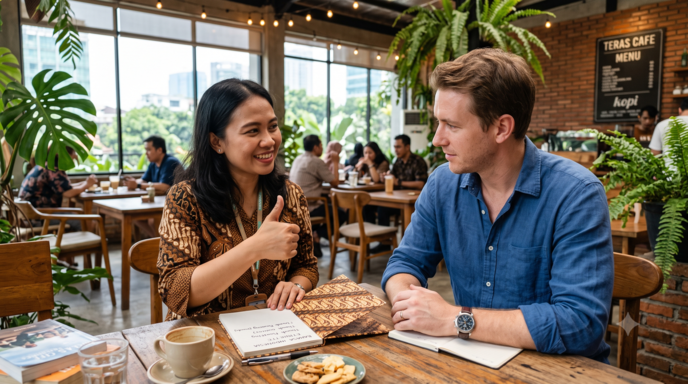
1. The Right-Hand Rule & Body Language
In Indonesian culture, body language speaks volumes. Certain everyday gestures that seem harmless in Western countries carry strong cultural meanings here.
DO use your right hand for everything official: Always use your right hand to give or receive items, pay money, or shake hands. The left hand is traditionally considered unclean (reserved for personal hygiene). If your right hand is full, excuse yourself by saying “Maaf, tangan kiri” (Sorry, left hand).
DON’T point with your index finger: Pointing directly at someone or something with your index finger can be perceived as aggressive or rude. Instead, point gently using your right thumb while keeping your hand loosely folded into a fist.
DON’T touch someone’s head: The head is regarded as the most sacred part of the body. Avoid touching anyone’s head, including young children, as it is seen as disrespectful.
DON’T place your hands on your hips: Standing with hands on hips (bertolak pinggang) is locally interpreted as an expression of anger, defiance, or arrogance.
2. Greetings, Respect, and Hierarchies
Respecting elders and authority figures is deeply embedded in the social fabric of Indonesia (Sopan Santun).
DO use polite honorific titles: Address people using respectful titles before their names. Use Pak (Sir/Mr.) for adult men and Bu (Ma’am/Mrs.) for adult women. For younger adults or service staff, Kak (older brother/sister) is widely appreciated and friendly.
DO offer a gentle handshake: When meeting someone, a light handshake accompanied by a warm nod or smile is standard. Some traditional locals may briefly place their hand over their heart after a handshake as a sign of warmth.
DON’T be overly assertive in public: Raising your voice, displaying public outbursts of anger, or demanding immediate answers disrupts the concept of Hormat (respect) and social harmony. Calm, polite discussions always yield better results.
3. Dressing Codes and Sacred Spaces
Indonesia is a diverse country with strong religious traditions, primarily Islamic, alongside Hindu, Christian, and Buddhist influences. Dressing appropriately shows respect for local communities.
DO dress modestly in public and sacred places: When visiting religious sites (mosques, temples, churches) or government offices, ensure your shoulders and knees are covered.
DO remove your shoes at the entrance: Always take off your shoes before entering a local home, a mosque, or certain traditional shops. Look for footwear lined up outside the door as a cue.
DON’T wear swimwear away from beach areas: While swimwear is completely fine at beach resorts and private pools in Bali or Lombok, cover up when walking into towns, local cafes, or convenience stores.
4. Dining Etiquette and Socializing
Food is central to Indonesian hospitality, and dining together is a primary way locals bond.
DO wait to be invited before eating or drinking: When visiting a local home, it is customary to wait until the host says “Silakan” (Please go ahead) before taking your first sip or bite.
DO accept food or drinks graciously: Even if you are not hungry or thirsty, accept a offered beverage or snack politely. Taking a tiny sip or bite shows appreciation.
DON’T pass food using your left hand: Just like passing money, always use your right hand when sharing dishes at a dining table.
5. Bridging the Cultural Gap with Language
Understanding cultural do’s and don’ts goes hand-in-hand with basic conversational skills. Showing an effort to speak the local language—even simple polite phrases like “Terima kasih” (Thank you) or “Permisi” (Excuse me)—instantly melts barriers and earns immense appreciation from locals.
If you are just starting out, reviewing our The Ultimate Guide to Learning Bahasa Indonesia for Beginners (2026 Edition) will give you the core vocabulary you need to complement your cultural knowledge.
🚀 Elevate Your Expat Journey in Indonesia
Navigating a new culture becomes much easier when you can speak the language fluently. Join our flexible Bahasa Indonesia Courses—tailored specifically for foreign professionals, expats, and travelers.
Other articles :
Learn Indonesian Language and Strengthen Your Professional Network in Indonesia
Cross-cultural Communication In Indonesian Workplaces
Business Bahasa Indonesia Etiquette: How to Address Colleagues
Polite Indonesian Phrases for Expats: Speak Respectfully & Introduce Yourself
Can Foreigners Work Remotely in Bali Legally? (Taxes & E33G Visa Explained)
Understanding Indonesian Visas: A Guide to B211A, KITAS, and Golden Visas